3d Building Art ââ“ Building Tunnel Country and City?
Commodity
State of the Art in 3D City Modelling
Half dozen Challenges Facing 3D Data equally a Platform
Semantically enriched 3D urban center models have the potential to be powerful hubs of integrated information for calculator-based urban spatial analysis. This article presents the state of the art in 3D city modelling in the context of broader developments such every bit smart cities and digital twins, and outlines half-dozen challenges that must be overcome before 3D data as a platform becomes a reality.
(This article is a co-production of seven authors, all of whom are mentioned at the end of the text.)
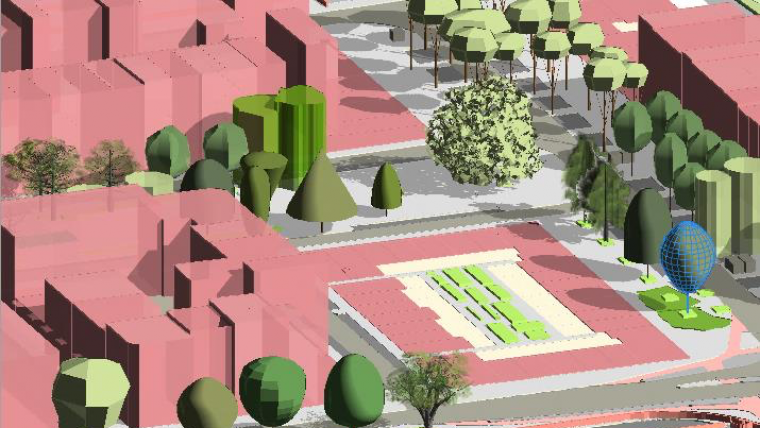
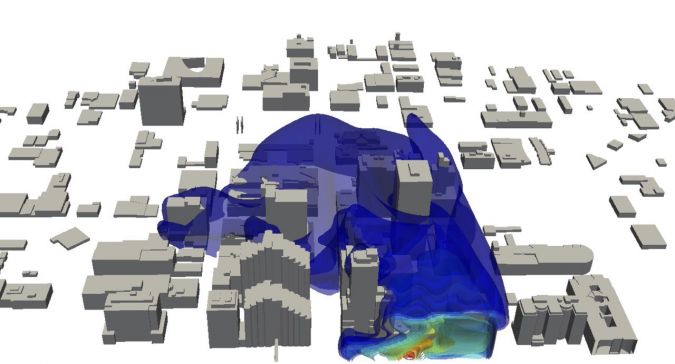
3D city models, as digital representations of urban areas, can be used to facilitate many applications, such equally urban wind and dispersion simulations, energy studies, noise studies and various types of assay that require a planned architectural design to be placed in its context (east.g. line of sight and shadow analysis, clash detection with cables and pipelines in the underground, impact of wind circulation, see Figure ane). These 3D models, which also contain semantics, are different from 3D meshes (as constitute in calculator graphics and the gaming globe) and from raw signal clouds. These tin be used for visualization and visual assay, but they are not suitable for most other spatial analysis purposes.
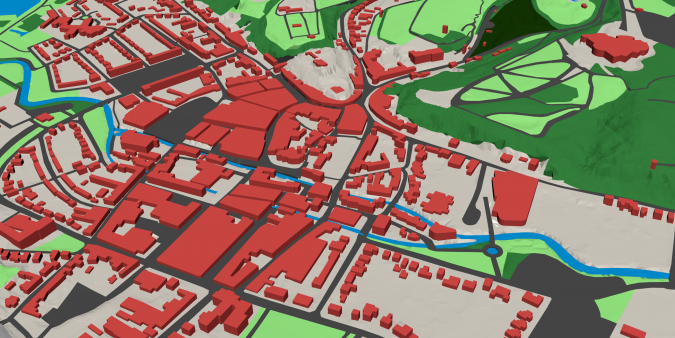
In guild to permit for the development of advanced applications, a 3D city model should depict the geometry and attributes of all the individual elements that are typically nowadays in a city, due east.m. the terrain, roads, water bodies and buildings (Effigy 2). In add-on, relevant semantic information tin be included with the geometries, such as the year a edifice was constructed, the number of people living in it and the construction materials it is fabricated of – all important information to optimize circular economy flows or energy consumption. Such semantically enriched 3D city models potentially represent powerful hubs of integrated information to be used for computer-based urban analysis purposes, including in the context of broader developments such as smart cities and digital twins.
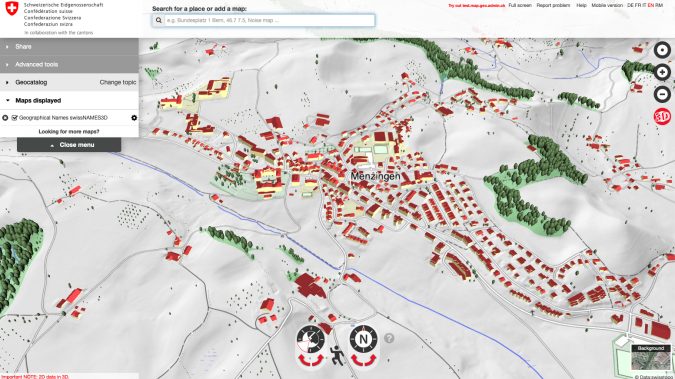
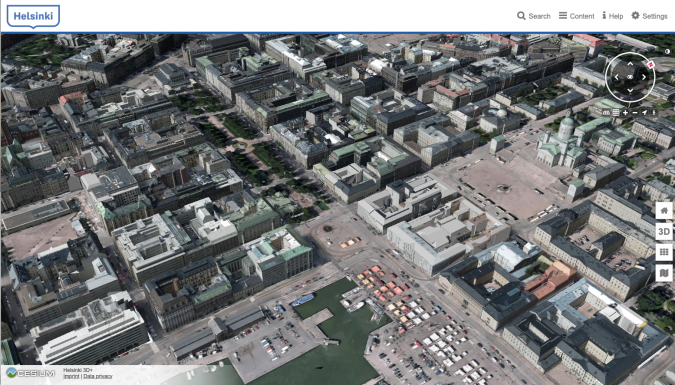
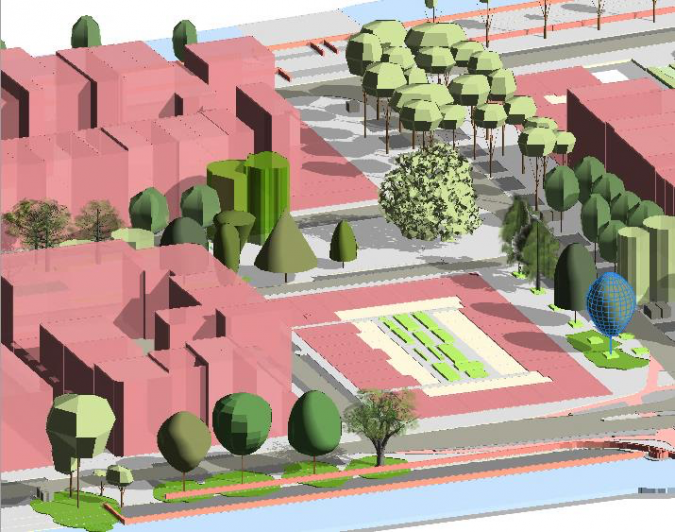
Advances in technologies for the collection of 3D height information through Lidar and photogrammetry have fabricated it relatively easy for practitioners in different fields to automatically reconstruct 3D urban center models (see Effigy three for a couple of examples). These models typically contain mainly buildings, but other object types are increasingly beingness included too, such equally roads, bridges, trees (meet Figure 4) and h2o. The availability and applications of 3D models are still increasing in the fields of city planning and environmental simulations, as listed above. Furthermore, since superlative data tin be caused at relatively depression cost, this information can be often updated. It is also possible to reconstruct 3D city models covering the same region at different periods in time.
3D city models accept the potential to play a crucial role in shaping the future. This holy grail of 3D city models that goes beyond 3D visualization requires an integrated approach to 3D city modelling based on the implementation of 3D data equally a platform. In this approach, the aforementioned upwards-to-date, 3D virtual representation of reality serves different urban applications and at the same fourth dimension offers an environment for integrating the findings of different applications. Still, before 3D data as a platform becomes a reality, the following challenges must be overcome:
Challenge i: Consistency between Models
The showtime challenge is the lack of consistency betwixt 3D urban center models covering the same area. Currently, 3D urban center models are generated independently, often using different base of operations (sensor) data, reconstruction methods and software. Therefore, the resulting models oft significantly differ in their geometry (east.g. a collection of surfaces versus a volumetric representation), advent and semantics. Moreover, as these models are stored using different formats (XML, graphics or binary formats), their underlying information models oft besides differ. Substantial differences can even occur when models that were originally identical are processed independently, either through mismatched updates or through conversions between different formats (e.g. in an attempt to deal with software incompatibilities). All these differences take profound consequences in practice, such as affecting the applications for which a 3D model can be used, the processing that is necessary to use it and the likely errors that volition be present in the cease result. Information technology is thus important to be aware of the way 3D urban center models are modelled and to provide this data explicitly in the metadata of the model.
Claiming two: Standardization
To ensure consistency, both for geometry and semantics, standardization is essential. The OGC standard CityGML is the main standard for storing and exchanging 3D semantic city models. Its aim is to define the basic classes that tin be used to describe the most common types of objects present in a 3D city model, their components, their attributes and the relationships betwixt different objects. Although most CityGML examples and datasets focus on buildings, CityGML also represents other feature classes, such every bit state employ, relief, roads and railways, vegetation, bridges and city article of furniture. While CityGML prescribes a standard information model for a 'generic' city, information technology is possible to extend it for specific domains by defining application domain extensions (ADEs), such as for the energy demand of buildings or for a country-specific data model. The main issue with ADEs is that software packages and libraries often cannot automatically read and process the application-specific information from them considering extensions do not need to follow many prescribed rules.
CityGML is used both equally an information model (in the form of UML models of its classes) and an encoding model, which is an XML-based representation using geometric definitions from the Geography Markup Language (GML). One challenge when working with CityGML-encoded data is that software back up for CityGML is notwithstanding limited. This is partly due to the huge number of possible ways in which objects can be divers in CityGML, which makes full implementation difficult (i.east. the software needs to support all possible situations). In add-on, XML (and thus GML) can be verbose and complex, which makes information technology impractical for many applications.
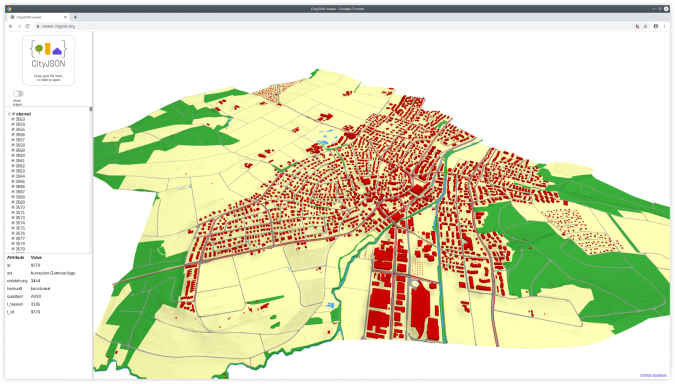
There are other solutions that implement the CityGML data model to overcome these problems. I is 3DCityDB, which is an open up-source database, built upon Oracle Spatial or PostGIS, to store the CityGML data model in a relational database. Another alternative to CityGML encoding is CityJSON, which is a format that encodes a subset of the CityGML data model using JavaScript Object Notation (JSON). CityJSON was designed with programmers in listen, so that tools and APIs supporting information technology can exist quickly built. It is likewise designed to be compact, with a compression factor of around half-dozen when compared to XML-based CityGML files, and is friendly for web and mobile evolution (i.due east. it supports the use of 3D information beyond exchanging data). CityJSON v1.0 was released in 2019 and is supported in several software packages including viewers, 3D modellers, 3D metropolis model generators and GIS software (Figure 5).
Challenge 3: Data Quality
Quality – or lack of it – is another issue that limits the sharing of 3D city models between unlike software systems and applications. Every bit highlighted by Biljecki et al. (2016), about openly available 3D urban center models contain many geometric and topological errors, east.k. duplicate vertices, missing surfaces, self-intersecting volumes, etc. Oftentimes, these errors are not visible at the scale on which the datasets are visualized or they are not a trouble for the specific software in which they are modelled. Equally a consequence, practitioners are unaware of the issue. However, these errors prevent the datasets from being used in other software and for advanced applications, and that is essential to facilitate 3D data as a platform. All these geometric errors could be prevented if modelling software forced the 3D geometries to comply with ISO 19107, i.due east. connecting surfaces, planar surfaces, correct orientation of the surfaces, watertight volumes, etc. Some other solution to this problem could be to use automated repair algorithms. However, these are nevertheless often semi-manual, plus it is possible that fixing i error could innovate a new ane elsewhere.
Challenge 4: Data Interoperability
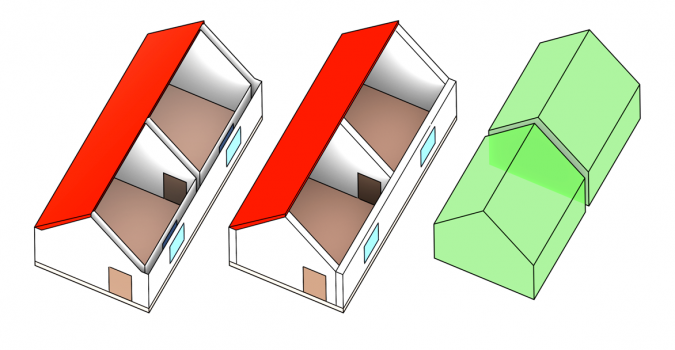
The conversion of semantic 3D city models from one format to some other is challenging, both from a geometric betoken of view and because of incompatible semantics. In the case of the IFC standard used in edifice data modelling (BIM), it is desirable to integrate into a 3D urban center model the highly detailed models that take already been generated for the design and construction of a building. However, the automatic conversion between IFC models and CityGML models is non straightforward. For a edifice which is modelled according to both standards, for instance, the mappings between the semantic classes are complex considering different semantic information is attached to the geometrical primitives in the two models. Moreover, IFC has many more than classes, whereas CityGML contains a limited number of classes structured in a hierarchy. In addition, a simple house tin easily be made up of a thousand volumetric elements in IFC, whereas in CityGML it contains but the outer beat out and a few other elements such equally doors, windows and chimneys. As a consequence of these differences in semantics, coupled with the fact that different software and geometric modelling paradigms are used, it is rather difficult to reuse data from other domains. OGC (2016) and Approach Ohori et al. (2018), amid others, explain in more detail the issues preventing automation of the process and provide recommendations for meliorate alignment of both standards. This requires a better understanding of how detailed BIM models are needed in GIS-based applications and how GIS-contextual data can be meliorate accessed from BIM software. Deriving the GIS-relevant concepts from a detailed BIM model that tin act as an interface between both domains is considered as a crucial step forrard (see Figure 6). In addition, georeferencing of BIM models is needed to be able to locate them in their geographical context.
Challenge five: Information Maintenance/Governance
Many governmental organizations have invested in their ain 3D metropolis models. Even so, despite growing sensation of the importance of upwardly-to-appointment 3D city models, they often fail to put strategies in place for updating the models and maintaining different versions of the data. One potential method to exercise and then would exist to use data nigh new designs structured in IFC/BIM models. However, this requires good agreements regarding the blueprint data to be submitted and the preprocessing of the IFC/BIM data (e.g. deriving georelevant concepts such as the footprint and outer envelope in a georeferenced context), as well equally organizational/institutional agreements (i.east. Who is responsible for the data? How can it exist ensured that the IP of the builder/designer is respected?).
Challenge vi: From Utopian Pilots to Real-world Use Cases
Technical innovations regarding 3D data usage that await promising in prototypes and pilots may encounter problems in exercise. A real-world production setup ordinarily covers larger areas and requires more automation, which can make it more than difficult to monitor and command the information quality. In add-on, solutions that work well for pocket-sized test areas are pushed beyond their limits (both in terms of performance and situations they accept to comprehend) when practical to large areas like complete cities or even countries. Further attending is therefore needed to obtain college-quality 3D urban center models and building models and so that they tin indeed form the footing for a 3D information platform serving a broad diverseness of urban applications. This requires more precise definitions of specifications, too as validation mechanisms to check whether the 3D information acquired meets those specifications. 'Higher quality' does not necessarily mean 'greater precision'; information technology means upwardly-to-date 3D data without errors and aligned with the specific needs of urban applications rather than serving visualization purposes only.
Not all challenges facing 3D data as a platform are technical ones. Organizations that desire to implement 3D as a platform often lack the latest knowledge and skills to do so. This tin can range from gaps in their knowledge of problems regarding the conquering, maintenance and dissemination of 3D data, to a lack of agreement of urban data quality, how to express it in metadata and how information quality impacts on the outcome of urban applications. There are also institutional and organizational bug facing 3D data, e.1000. what 3D information should be available, where and how it should be available, who is responsible for updates and maintenance, and how to integrate larger-calibration public-sector 3D city models with detailed individual-sector architectural models of individual buildings.
Conclusions and Future Outlook
More and more 3D city models are becoming available at different levels of item, for different periods in time and for dissimilar applications. It is therefore of import to have adequate ways to store such historical collections of 3D city models in a manner that is both standardized and structured with semantics. The ability to translate the physical world into a virtual reality has become a valuable asset in the design, planning, visualization and management of a wide range of urban applications such equally noise, heat stress, pollution, etc. However, an increase in complexity (i.e. 3D city modelling beyond visualization) often comes at the expense of usability, interoperability and maintenance. Current practices nevertheless evidence a lack of specific and convenient software to bargain with 3D metropolis models, also as several disconnected and inefficient software options, while data integration is an inherent component in 3D metropolis modelling. This integration needs further attention in order for 3D city models to serve as 'digital twins' of reality and provide data for a wide variety of applications. The integration of sensor data in a 3D urban center model is another expanse that needs further evolution to plow 3D city models into dynamic representations of reality. Lastly, the integration of highly detailed and differently structured IFC/BIM models remains an area for farther study likewise as for further agreements to support integration.
This article has listed the current challenges standing in the fashion of 3D urban center models being used for sustainable urban environments. Based on this list, it may seem as though a lot yet needs to be done. While that is true, over the past decades there has of course been a huge increase in the number of 3D urban center models bachelor and many developments in terms of acquiring, modelling, maintaining, using and visualizing them. All of this has laid a foundation for realizing the potential of 3D city models. By tackling the challenges described in this commodity, another major footstep can be taken and then that the 3D city model indeed will become a powerful information hub that can be used for computer-based urban analysis.
Acknowledgements
This project has received funding from the European Inquiry Council (ERC) nether the European Spousal relationship's Horizon 2020 research and innovation plan (Grant Agreement No. 677312 UMnD).
Further Reading
- Arroyo (2018) Ohori, One thousand, Abdoulaye Diakité, Thomas Krijnen, Hugo Ledoux and Jantien Stoter. 2018. Processing BIM and GIS models in practice: experiences and recommendations from a GeoBIM project in the netherlands. ISPRS International Journal of Geo-Information 7(eight), August 2018.
- Biljecki et al. (2016). The most mutual geometric and semantic errors in CityGML datasets. F. Biljecki, H. Ledoux, 10. Du, J. Stoter, Thou. H. Presently and V. H. S. Khoo. ISPRS Ann. Photogramm. Remote Sens. Spatial Inf. Sci., 2016, pp. 13–22.
- OGC (2016) Open Geospatial Consortium inc., 2016. OGC. Future City Pilot-i: Using IFC/CityGML in urban planning engineering report. http://docs.opengeospatial.org/per/16-097.html
- Ortega-Córdova (2018), Lessie Yard., Framework for Urban Vegetation 3D Modelling. MSc thesis,, https://repository.tudelft.nl/islandora/object/uuid:8b8967a8-0a0f-498f-9d37-71c6c3e532af?drove=education
- Sanchez (2017), Quantifying inflow uncertainties for CFD simulations of dispersion in the atmospheric boundary layer, García-Sánchez, Clara, PhD thesis, Antwerp University, Sciences Kinesthesia, https://hdl.handle.internet/10067/1460450151162165141
Prof Dr Jantien Stoter
About the authors
Dr Ken Arroyo Ohori is a postdoc researcher in the 3D Geoinformation research grouping. His research interests include college-dimensional (4D+) GIS representations and algorithms, geometric modelling and processing, GeoBIM integration and automated information repair.
Balázs Dukai, MSc, is a enquiry software engineer in the 3D Geoinformation research grouping. His focus is on methods for generating datasets, and writing software.
Anna Labetski, MSc, is a PhD candidate in the 3D Geoinformation inquiry group, focusing on the generalization of 3D urban center models. Her research interests include generalization, levels of particular, transportation networks, active transportation and metadata.
Kavisha Kumar, MSc, is a PhD candidate in the 3D Geoinformation group. Her research includes compact representation of massive 3D city models for efficient storage and management.
Stelios Vitalis, MSc, is a PhD candidate in the 3D Geoinformation group. His research interests are versioning of 3D city models, multi-dimensional GIS information, topological data structures and GIS software development.
Dr Hugo Ledoux is an associate professor in the 3D Geoinformation research group. His work is mostly focused on semantic urban center modelling and computational geometry.
Keep abreast of news, developments and technological advancement in the geomatics industry.
Sign upwardly for gratuitousSource: https://www.gim-international.com/content/article/state-of-the-art-in-3d-city-modelling-2
0 Response to "3d Building Art ââ“ Building Tunnel Country and City?"
Post a Comment